

Optimizing Efficiency: The Role of Precision Control Valves for Small Flow Rates in Pharmaceutical Manufacturing
- 2026-08-19 11:50:01
- admin
- NO COMMENTS
Enhancing Process Efficiency in Pharmaceutical Manufacturing through Precision Small-Flow Control Valves
In a pharmaceutical dosing room, small-flow instability rarely announces itself with a major alarm. More often, an engineer watching a batch trend notices that a 4–20 mA command remains almost steady while the actual liquid flow keeps moving around the target. The valve opens a fraction, the flow jumps too far, the controller corrects in the opposite direction, and the cycle repeats. On the production floor, this may show up as a longer dosing step, an inconsistent transfer volume, or a formulation that takes several extra minutes to settle within specification.
Another familiar sign appears during maintenance. A valve that moved smoothly at commissioning begins hesitating near 10–15% travel. Stem friction has increased, the seat has accumulated residue, or the actuator-positioner combination can no longer resolve the tiny movements demanded at low flow. Small deviations matter here. A few liters per hour may represent a meaningful percentage of a dosing stream, buffer addition, purified-water feed, or cleaning-chemical injection.
The underlying sequence is usually gradual. Repeated low-amplitude movement increases friction around the stem and packing; that friction creates deadband; the controller keeps increasing its output until the valve finally moves; flow then overshoots, forcing another correction. What begins as a mechanical issue eventually becomes a pharmaceutical process control problem.
Introduction
The Necessity of Precision in Pharma Manufacturing
Pharmaceutical manufacturing leaves little room for uncontrolled process variation. Liquid transfers may involve active ingredients, buffers, purified water, cleaning chemicals, fermentation media, or intermediates whose flow needs to remain repeatable from one batch to the next.
FDA guidance for sterile drug manufacture places aseptic processing within the framework of current good manufacturing practice under 21 CFR Parts 210 and 211. Equipment used around sterile processing, therefore, has to support reliable operation, cleanability, contamination control, and validated production procedures rather than merely move fluid from one vessel to another.
In practice, engineers see the valve as one element of the measurement-and-control chain. A high-resolution flowmeter cannot compensate for a valve that sticks. A well-tuned controller cannot eliminate leakage through damaged trim. Likewise, a valve with excellent mechanical construction may still produce poor results if its Cv is several times larger than the actual process requires.
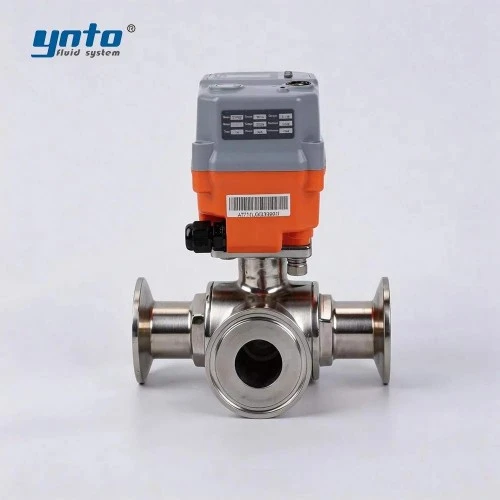
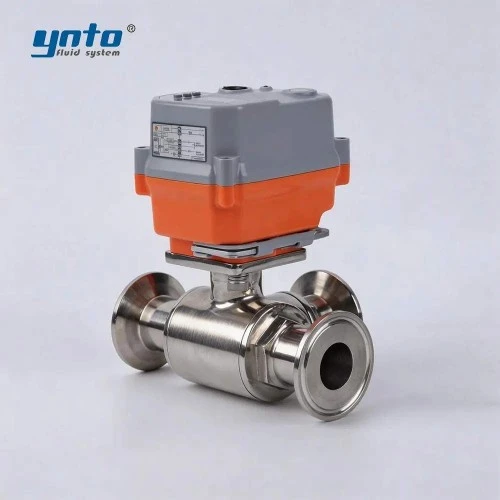
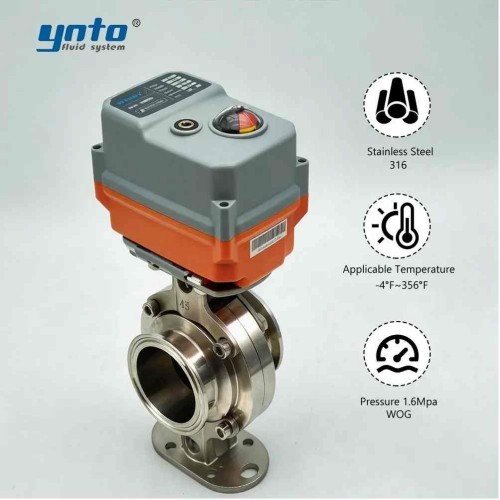
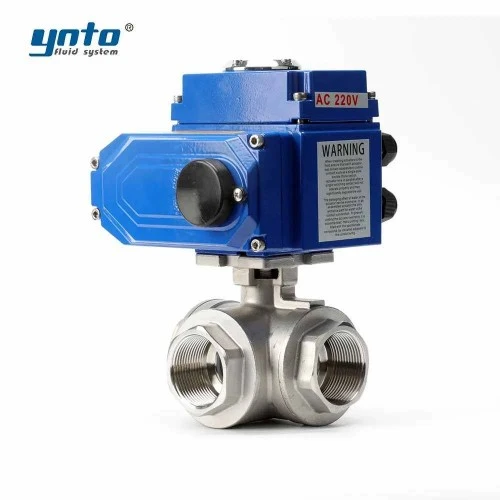
For electrically automated dosing or utility loops, an electric single-seat control valve provides one relevant starting point. CNYNTO specifies 4–20 mA control, small-leakage single-seat construction, and use in pharmaceutical and other process industries. Its final suitability for a pharmaceutical duty still depends on the medium, required cleanliness, pressure, temperature, and validated process boundary.
Defining Small Flow Rates
There is no single universal flow value at which a pharmaceutical application suddenly becomes “small flow.” The practical definition is relative to the line size, control-valve capacity, instrument range, and process tolerance.
A 100 L/h stream may be small in a DN50 utility line but significant in a formulation skid. What matters is whether the valve can regulate the required minimum and maximum flow without spending most of its operating life at the edge of its usable travel.
During commissioning, I usually become suspicious when a control valve sits below roughly 10% opening for long periods while the flow signal oscillates. The exact percentage is not a universal design limit, but the behavior often indicates that the installed Cv is too large or that valve authority is poor.
Oversizing creates its own cause-and-effect pattern. A very small stem movement produces a disproportionately large change in effective flow area. Flow rises too quickly, the controller pulls the signal back, and the loop begins hunting. The process engineer may then blame the PID settings when the deeper problem is valve sizing.
Key Components of Precision Control Valves
Types of Valves and Their Functions
Valve selection begins with what the process actually needs.
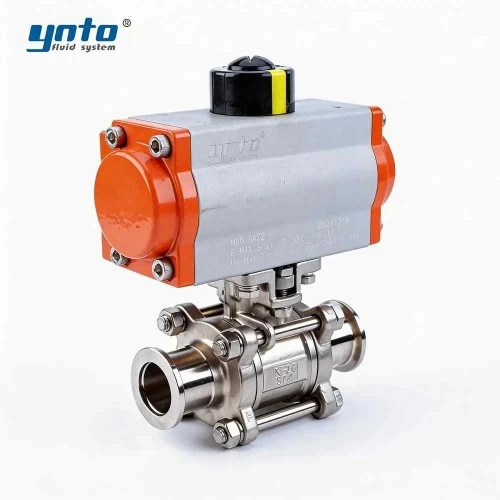
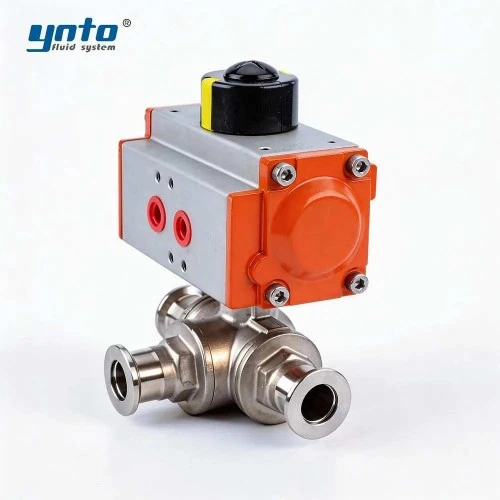
Single-seat globe-style control valves are useful where fine modulation and relatively low leakage are important. Diaphragm valves become attractive where cleanability and isolation of the operating mechanism from the process fluid matter more. Ball valves provide excellent shut-off and low pressure drop, but standard full-port designs are usually better at isolation than very fine low-flow throttling unless fitted with characterized trim.
For sanitary duties, internal geometry matters as much as nominal pressure rating. Crevices and stagnant pockets can trap process residue or cleaning fluid. The best valve is therefore not necessarily the one with the highest pressure class; it is the one whose hydraulic characteristics, cleanability, material, and actuator behavior match the validated process.
Pneumatic Control Valves
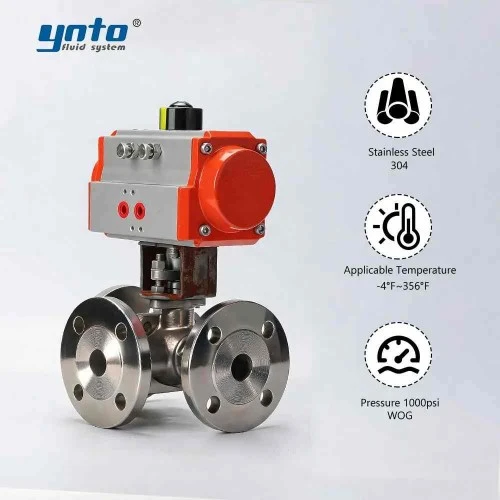
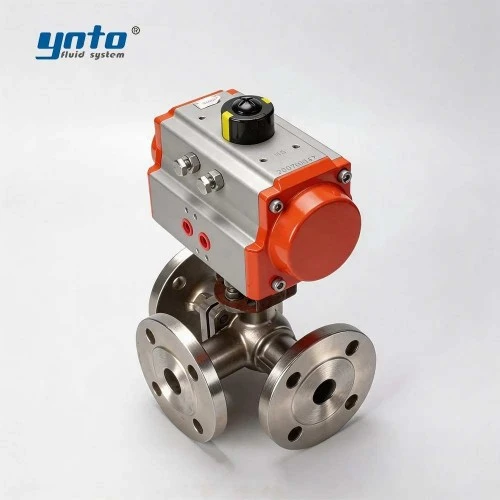
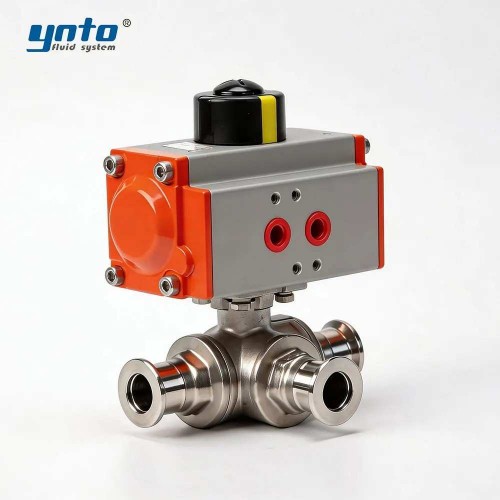
Pneumatic control valves remain common in pharmaceutical plants because compressed-air actuation is simple, fast, and readily configured for fail-safe operation.
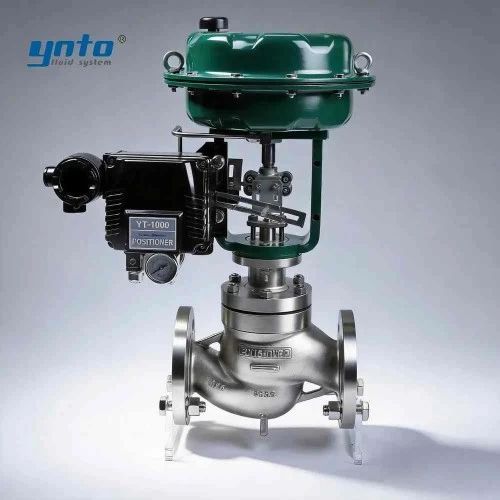
The weakness usually appears between the positioner and the valve stem. If packing friction increases, the positioner may continue increasing air pressure without actual valve movement. Once the force finally exceeds static friction, the stem jumps. At a large flow rate, that jump may be tolerable. At a small flow rate, it can represent a substantial process disturbance.
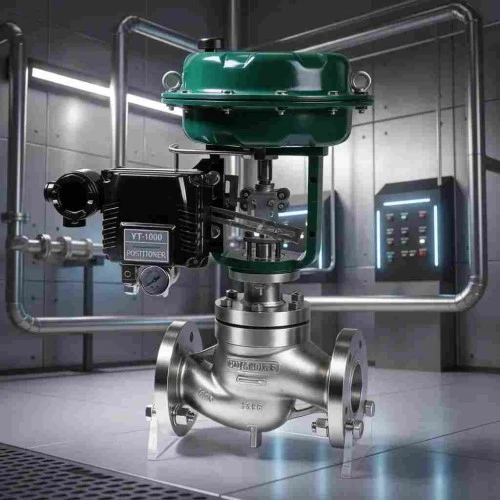
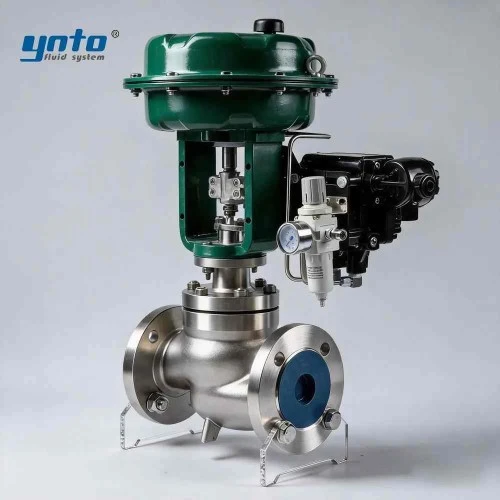
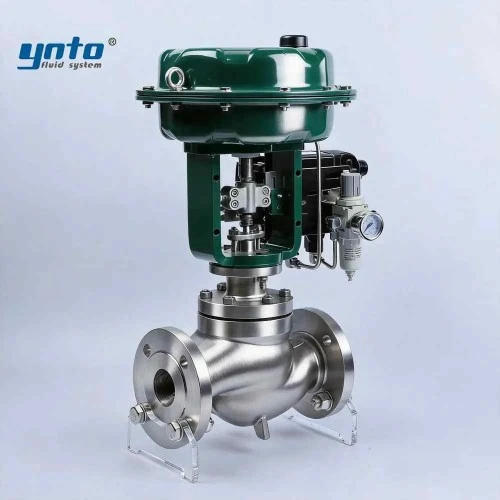
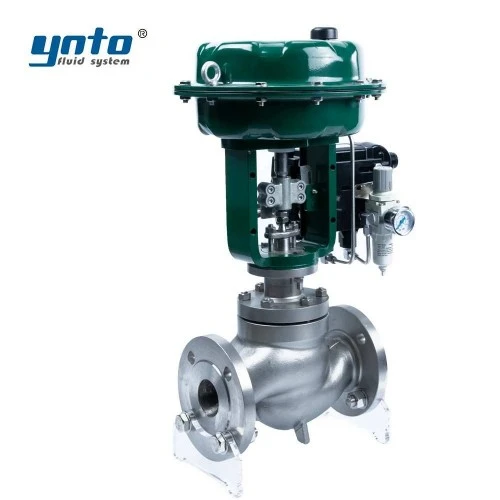
A pneumatic single-seat control valve is designed for modulating liquids, gases, and steam with pneumatic actuation. CNYNTO lists analog and digital control options and emphasizes precision-machined trim for flow regulation. For pharmaceutical use, the buyer should additionally specify the required wetted-material finish, elastomer compatibility, cleanability, documentation package, and sanitary connection details.
Actuator sizing should include differential pressure, packing friction, required shut-off force, air-supply pressure, and a realistic safety margin. Oversized actuators are not always better; they can make the assembly physically larger and less sensitive. Undersized actuators create a more serious problem—slow travel or incomplete seating when process pressure rises.
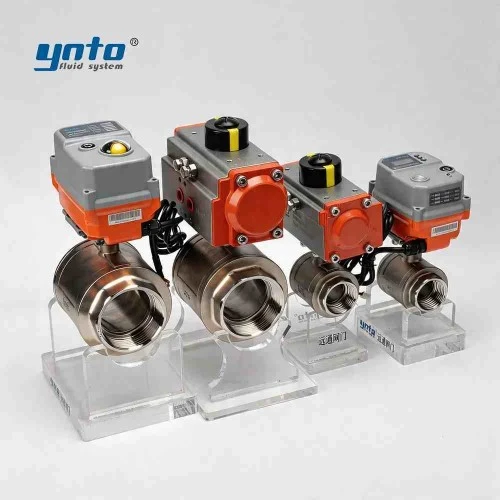
Electronic Control Valves
Electronic actuation is increasingly useful where compressed air is unavailable or where the process requires direct integration with a distributed control system.
For small-flow duties, position resolution matters more than raw actuator speed. An actuator capable of moving quickly but unable to hold a stable intermediate position will produce poor control. Engineers should therefore review backlash, feedback resolution, command type, travel time, duty cycle, and fail-safe behavior.
The same principle applies when pneumatic valves use electronic positioning. A YT1000 electro-pneumatic positioner accepts a DC 4–20 mA control signal and drives pneumatic rotary actuators according to that command. In a well-sized loop, this type of feedback device can reduce the gap between controller output and actual valve position; it cannot, however, correct an oversized valve or severe mechanical stiction.
Materials and Specifications
Product-contact pharmaceutical service usually pushes material selection toward cleanable, corrosion-resistant construction.
316L stainless steel is widely used because it combines mechanical strength with good corrosion resistance and can be finished to smooth internal surfaces. For unusually aggressive chloride environments, Duplex or Super Duplex may offer higher corrosion resistance, although these materials are less common in ordinary sanitary product-contact loops.
PTFE is valuable where broad chemical resistance and low friction are required. EPDM is frequently considered for water-based and cleaning duties, while FKM offers different resistance characteristics for solvents, temperature, and chemical exposure. Each elastomer needs to be checked against the actual formulation and CIP/SIP chemistry rather than selected from a generic chart.
Carbon steel and alloy steel remain useful in plant utilities—steam, compressed gases, and certain non-product-contact services—but they are generally less attractive for hygienic wetted surfaces. FBE or Halar coatings can protect metal in corrosive utility environments, yet a coated valve should not automatically be assumed suitable for direct pharmaceutical product contact without validation.
Critical Applications
Liquid Handling Systems in Pharma
Liquid handling systems are where small-flow control problems become visible quickly.
A buffer-addition line may need to change from 60 L/h during preparation to only 8 L/h near the end of the batch. If the valve cannot maintain stable control at the lower value, the controller oscillates and the final concentration approaches its target less smoothly.
The same issue appears in purified-water dosing, antifoam addition, pH correction, cleaning-chemical preparation, and chromatography support systems.
For an engineer, the most useful diagnostic is to compare three trends together: controller output, actual valve position, and measured flow. If the command changes but the position does not, mechanical stiction or actuator resolution deserves attention. If the position moves smoothly but the flow jumps, valve sizing, pressure variation, or flowmeter range may be the problem.
Sterile Processing Equipment and Its Importance
Sterile processing equipment introduces another priority: preventing contamination while maintaining controllability.
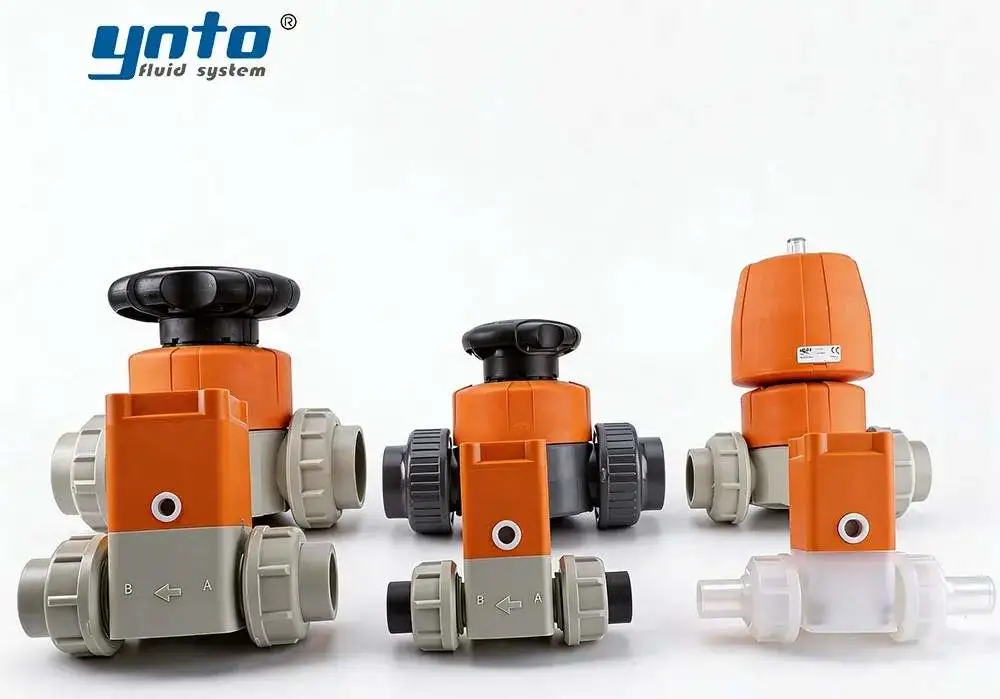
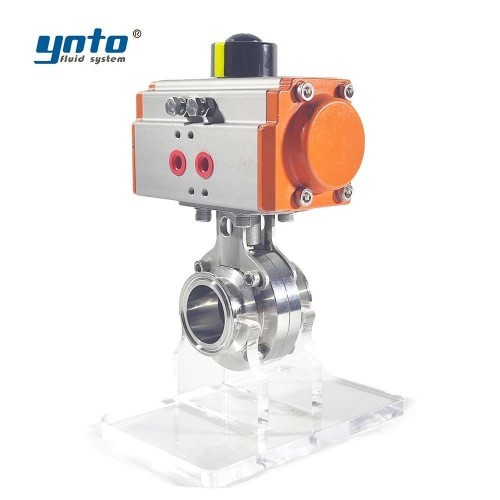
Diaphragm valves are useful because the flexible diaphragm separates the process fluid from the stem and much of the actuator mechanism. A stainless steel pneumatic diaphragm valve uses 316L stainless construction and pneumatic operation, and CNYNTO positions the design for pharmaceutical and food-grade service with CIP/SIP capability.
ASME BPE is particularly relevant here. The current ASME BPE 2026 standard covers materials, design, fabrication, inspection, testing, and certification for equipment used in bioprocessing and pharmaceutical applications requiring elevated hygienic control.
Safety should remain part of the valve specification. A sterile line may still see pressurized hot water, clean steam, caustic CIP solution, or acidic cleaning fluid. A small packing or diaphragm failure can expose personnel and compromise the batch simultaneously. Pressure rating, temperature capability, elastomer compatibility, drainage, and isolation procedures therefore need to be evaluated together.
Enhancing Control Loop Tuning
Techniques for Effective Loop Tuning
Control loop tuning should begin only after confirming that the mechanical system is healthy.
A common mistake is to change PID values repeatedly while ignoring valve stiction. If the stem does not respond smoothly to small commands, aggressive proportional or integral settings simply make the controller chase the problem faster.
For small-flow applications, engineers should first verify flow meter range, valve Cv, valve characteristic, actuator resolution, supply pressure, and position feedback. The loop should then be tested at several operating points rather than tuned only at nominal flow.
A stable low-flow loop often benefits from slower, deliberate correction rather than aggressive movement. The aim is not the fastest possible response. It is a repeatable response without overshoot.
Benefits of Proper Tuning in Small Flow Rates
Good control loop tuning reduces process variability.
When the valve moves proportionally to the controller output, a small concentration correction remains small. The batch does not oscillate around the target. Pump demand becomes steadier. Chemical consumption is easier to forecast.
Poor tuning has the opposite effect. Pressure changes disturb flow, the controller responds too strongly, the valve repeatedly changes direction, and increased cycling accelerates mechanical wear. Over months of operation, an unstable control loop can become a maintenance problem as well as a process problem.
Adhering to Manufacturing Compliance Standards
Overview of Compliance Standards in Pharma
Pharmaceutical valve compliance is not defined by one universal standard.
FDA aseptic-processing guidance operates within CGMP expectations under 21 CFR Parts 210 and 211. For hygienic mechanical design, ASME BPE provides requirements specifically associated with bioprocessing and pharmaceutical equipment.
ANSI/ASME B16.34 is more general. Its scope includes pressure-temperature ratings, materials, dimensions, testing, and marking for applicable industrial valves. It is useful when pressure-boundary design is relevant, but it does not replace pharmaceutical hygienic-design requirements.
API 598 covers industrial valve inspection and testing. It may appear in utility or general-process specifications, but it should not be presented as a pharmaceutical GMP standard. API currently lists Standard 598 as “Valve Inspection and Testing.”
ISO 5211:2026 specifies standardized interfaces and torque references for part-turn actuator attachments. DIN standards also affect pharmaceutical installations; DIN currently lists standards for hygienic and aseptic stainless-steel connections used in chemical and pharmaceutical industries, while DIN EN 558 governs face-to-face dimensions for applicable flanged metal valves.
Role of Precision Control Valves in Compliance
A valve does not make a process compliant by itself. It helps the process remain controllable and repeatable.
Repeatability supports validated manufacturing. Cleanable geometry reduces opportunities for retained product. Correct materials reduce corrosion and extractable contamination. Reliable actuation reduces unexplained process deviations.
For high-purity transfer points where manual sanitary isolation is needed, a sanitary diaphragm valve provides a 316L body, sanitary internal geometry, and EPDM/TFM or EPDM diaphragm options according to CNYNTO’s published specification. The site positions it for pharmaceutical liquid transfer, filtration, and purified-water systems.
For procurement teams, the useful question is therefore not simply, “Is this valve pharmaceutical grade?” It is, “Can the supplier document the materials, surface condition, pressure rating, sealing system, actuator behavior, connection standard, and testing needed for this validated application?”
Streamlining Process Optimization Strategies
Implementing Advanced Control Techniques
Process optimization strategies become more effective when the valve and control system are treated as one package.
Plants can combine flow measurement, valve-position feedback, recipe control, and trend analysis to identify deterioration before a batch is affected. If the actuator position begins oscillating while the process demand remains steady, maintenance can investigate the valve before the variation becomes a deviation.
Advanced control does not always mean complicated control. A correctly sized valve with clean feedback frequently outperforms a sophisticated algorithm acting through poor mechanical hardware.
Meanwhile, procurement should consider lifecycle support. Spare diaphragms, seats, packing, actuator seals, and positioner components need to remain available over the expected plant life. This is particularly important for validated equipment because replacing a component with a different design may trigger additional engineering review.
Measuring Efficiency Gains with Precision Control Valves
The most useful efficiency measures are operational.
Engineers can compare batch dosing time, flow deviation from setpoint, actuator movement frequency, cleaning duration, rejected batches, and maintenance interventions before and after optimization.
A properly sized control valve may reduce unnecessary actuator cycling. Better low-flow stability can reduce over-dosing and correction time. Improved sealing can reduce small product or utility losses. In sterile processing, better drainage and cleanability may also support more predictable CIP or SIP cycles.
These gains are not dramatic individually. Across hundreds of batches, they become significant.
Conclusion
Summary of Advantages
Precision control valves matter in pharmaceutical manufacturing because small flows magnify mechanical weaknesses.
An oversized valve turns minor movement into excessive flow change. Stem friction becomes deadband. Pressure fluctuations become process variability. Incompatible seal materials become leakage or contamination risks.
The engineering solution begins with correct Cv sizing, suitable valve authority, stable actuator response, appropriate flow measurement, and materials selected for the actual medium. Pneumatic control valves remain effective where fail-safe response and compressed-air infrastructure are available. Electronic and electro-pneumatic systems provide strong integration with modern automation. Diaphragm valves remain valuable around hygienic and sterile processing equipment where isolation of the process medium is particularly important.
Future Perspectives on Precision Control Solutions
Future pharmaceutical process control will rely increasingly on better diagnostics rather than simply faster actuators.
Position feedback, friction monitoring, valve-signature analysis, intelligent positioners, and predictive maintenance will make it easier to see a developing control problem before the batch record shows a deviation.
At the same time, hygienic design will remain fundamental. Digital communication cannot compensate for poor drainage, unsuitable elastomers, trapped product, or an incorrectly sized valve.
For engineers and procurement teams, the most reliable path remains surprisingly traditional: understand the process first, size the valve correctly, choose compatible materials, verify the actuator, then integrate the automation.
Do that well, and small-flow control stops being a persistent commissioning problem. It becomes a predictable part of the manufacturing process.
.png?imageMogr2/format/webp)
- 2026-09-30 08:25:23
- 2026-09-28 10:28:43
- 2026-09-21 15:23:44